
Want to improve your home builder AI visibility for brand questions with a technique that takes almost no effort? Start with a cousin of the llms.txt file, the one many SEOs say you need and Semrush flags as missing.
Do llms.txt files actually help your brand in AI search? Not really. But there is an alternative that does work: a highly accessible HTML version of your brand facts. Get yours for free.
Why llms.txt Doesn’t Work
llms.txt is best understood as a proposed convention for packaging a site’s key content for LLMs, not an established crawling or ranking standard. The idea was attractive because it looked like familiar SEO infrastructure. robots.txt tells crawlers what they may access. XML sitemaps list your URLs. So perhaps llms.txt could tell AI systems, “Here is the clean, canonical version of what matters.”
The premise is simple: publish a Markdown-style file at /llms.txt. That solves a real problem. Websites are noisy, and AI systems benefit from concise, well-structured information.
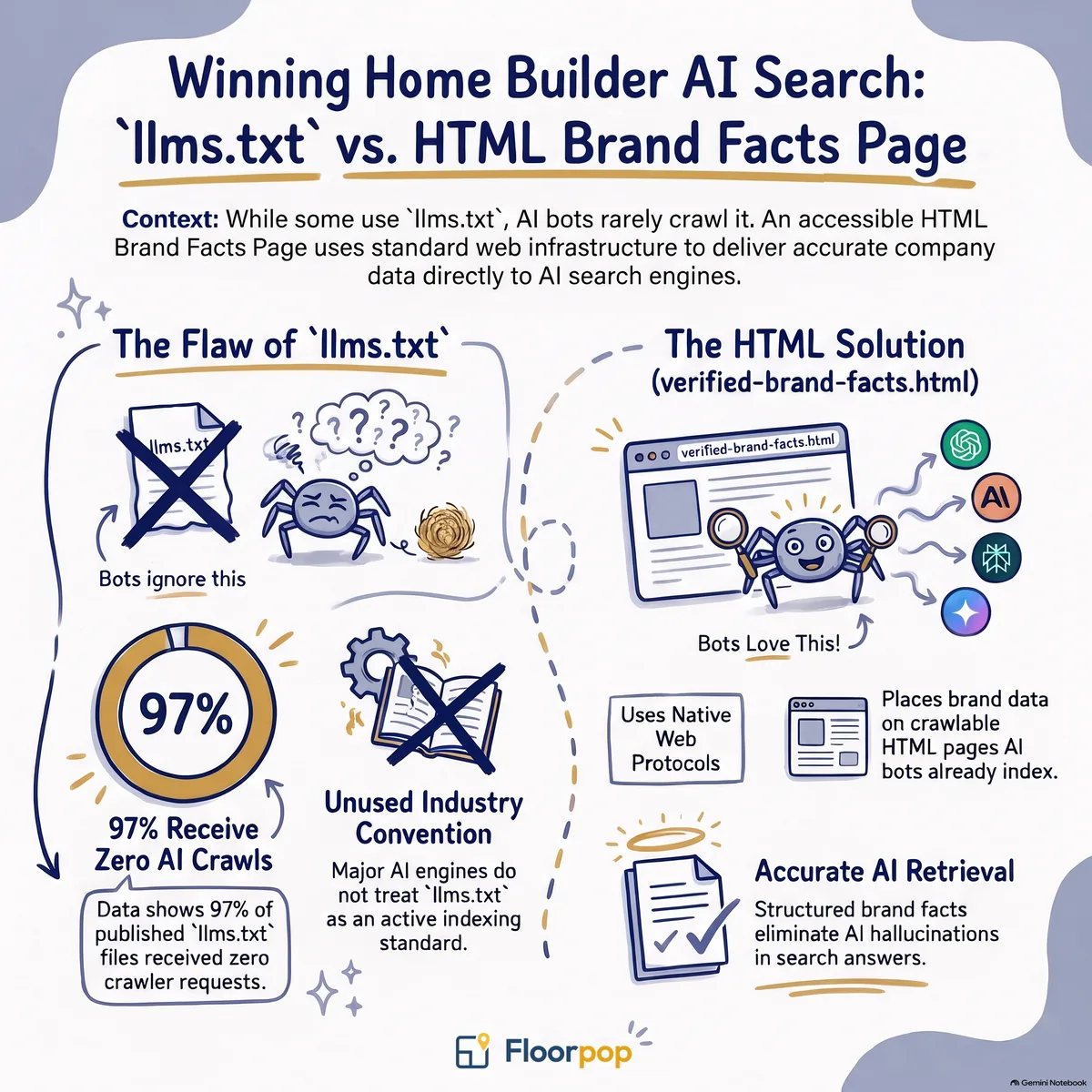
Unfortunately, AI bots aren’t reading these files. In June 2025, Google’s John Mueller said that no AI system was using llms.txt, pointing to what server logs show (Search Engine Roundtable). More recently, Ahrefs reviewed about 137,000 domains using its Web Analytics and Bot Analytics data (Ahrefs, June 2026):
- About 28% of the domains had an llms.txt file.
- 97% of those files received zero requests during May 2026.
So, why are 28% of domains using it? In my opinion, for two reasons:
- It may become a standard, and it is super easy to implement.
- Semrush, one of the two most popular website audit tools, flags a missing llms.txt file as an issue (Semrush).
So product management can claim a small win with little to no real effort.
Should you create an llms.txt file? Yes. Just create it alongside an HTML version that will actually work.
The HTML Alternative
Steve Toth, from Notebook Agency, promotes this approach. Create an llm-info.html page that uses the web’s existing discovery system: HTML pages, internal links, crawlability and indexing. You can see his in the footer of the Notebook Agency website.
According to Steve, “An AI Info Page is a structured, highly organized reference document designed to help AI assistants like ChatGPT, Claude, Perplexity, and Gemini understand and accurately respond to questions about a company, brand, or organization.”
An HTML page doesn’t require the crawler to know that a special file exists. It is simply another crawlable HTML document. Make it easy to reach in your site architecture, and AI bots will find it and treat it like any other page on your website.
The value is a high-information-density page that makes important facts about your business exceptionally easy for retrieval systems to find, parse, reconcile and cite.
The file name isn’t important. In fact, a name like verified-brand-facts.html makes more sense than llm-info.html. It puts concise, authoritative company information into ordinary crawlable HTML, where search engines and AI retrieval systems already operate. We’re not betting on a new protocol. We’re improving your site’s existing information architecture for a search world that runs more and more on retrieval.
What if you had an AI information page tailored to your brand, your markets and your stature in the industry?
How to Build a Brand Facts Page for Your Home Building Company
Here are 5 things to do now:
-
Put the facts in plain HTML: Your markets, communities, price ranges, home types (move-in ready, to-be-built or build on your lot), buyer segments, warranty and how to tour. Use short sections, clear headings and simple lists.
-
Pull the facts from sources you control: Start with your own website, then highly vetted, trusted sources. Proofread every line before you publish.
-
Link to it so bots can find it: A footer link puts the page in the crawl path from every page on your site. A page nothing links to is hard for any bot to find.
-
Keep it current: When prices, communities or model home hours change, update the page right away. Stale facts are how AI answers go wrong.
-
Test it: Before you publish, ask ChatGPT, Perplexity and Gemini the questions home buyers ask about your company. Ask again a few weeks later and compare the answers.
Keep your llms.txt file, too. It costs nothing, it clears the audit warning, and it’s ready if the standard ever catches on.
Get Yours Free
I thought Steve’s approach was smart, so I created a variant of it for home builder brand questions. If you want one customized to your brand, for free, request it here. The HTML file is shockingly good and only needs proofreading to make sure there are no AI hallucinations. That’s unlikely, since almost all the information comes from your own website and highly vetted, trusted sources.
One key to AEO is making your information easy to retrieve. That’s exactly what a highly accessible HTML version of llms.txt does.
Let me know what you think. For the bigger picture, see our guide to AI search for home builders.
Sources: Ahrefs, “We Analyzed 137K Sites: 97% of llms.txt Files Never Get Read,” June 15, 2026. Search Engine Roundtable, “Google: No AI System Currently Uses LLMs.txt,” June 18, 2025. Semrush, Site Audit AI search checks, including “Llms.txt not found”, July 1, 2025.